

There was once a young man who studied to become a poet. He wanted to be a poet by next Easter, so that he could marry and earn his living from poetry, which he knew was just a matter of making things up. But he had no imagination. He firmly believed he had been born too late. Every subject had been used up before he had a chance at it, and there was nothing in the world left to write about.
"How happy were the people born a thousand years ago," he sighed. "Then it was an easy thing to be immortal. Even those who were born a hundred years ago were lucky compared with me. They still had things left to make poems about. But now every subject is worn out, and it's no use for me to try my pen on such threadbare stuff."
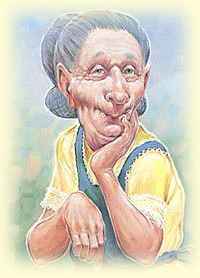
He thought about it, and worried about it, until he grew very thin and woe-begone, the poor fellow. No doctor could help him, but there was one person who would know just the remedy he needed to set him right. She was a little old lady, wonderfully wise, who lived in a tiny gate-house in the turnpike. She opened and closed the toll gate for everyone who rode by, but she was learned in the ways of the world. She was a clever woman, who could do more than open a gate, and she knew far more than the doctor who drives in his own carriage and pays taxes.
"I must go to her," the young man said. He found her house small and tidy, but most uninteresting. Not a tree, not a flower, grew anywhere near it. There was a beehive by her door - very useful; there was a potato patch - very useful; and over the ditch a blackthorn bush had flowered, and now bore fruit - very sour berries that puckered your mouth if you tasted them before they were ripened by frost.
The young man thought to himself, "What a perfect picture this is of the commonplace times we live in." But at least it had set him thinking. He had found the flash of an idea at the old lady's doorway.
"Write it down," she told him. "Crumbs are the same stuff that bread is made of. I know why you have come. You have no imagination, but you want to be a poet by Easter."
"Everything has been written before I was born, " he sighed. "Our times are not like the old days."
"Indeed they aren't," the little old lady agreed. "In the old days women like me, who knew dark secrets and how to cure by the use of strange herbs, were burned alive. In the old days poets went about with empty stomachs, and their clothes ragged and patched. Ours are excellent times, the best times of all. But your lack of imagination comes from not using your eyes, and not using your ears, and not saying your prayers at night. There are things all around you to write about, if you only knew how. You can find poetry in the earth, where it grows and flourishes. Whether you dip into the water of a running stream or a stagnant pool, you will find poetry. But first you must understand how to find it. You must learn how to catch the sunlight as it falls. Just try on my spectacles, listen through my ear-trumpet, say your prayers, and please, for once in your life, stop thinking about yourself."
That last request was asking almost too much of him. It was more than any woman, however wise and wonderful, should demand of a poet.
When he put on her spectacles and ear-trumpet, she turned him out into the potato patch, where she gave him a large potato to hold in his hands.
What did the potato find to tell him about? It told about itself and its forefathers, about the coming of the potato to Europe; about how unjustly it was suspected and abused before anyone realized that potatoes were far more valuable than any lump of gold.
"By the King's own order, we were distributed from the town hall of each city and village. A manifesto was issued to proclaim our great value and merits, but nobody believed it. No one had the least notion of how to plant us. One man dug a hole and emptied his whole bushel of potatoes in it. Another stuck them in the ground, far apart from each other, and waited for the potatoes to grow into trees, so one could shake them off the branches. They saw us grow buds and flowers and watery fruit, but it all withered away. No one thought to look for our real fruit, the potatoes that lay out of sight in the ground. Ah yes, we suffered many abuses - at least our forefathers did - but it was all for the best. Now you know our story."
"That will do," the old lady said. "Come and look at the blackthorn bush."
"We too," said the blackthorn, "have many relations in the land from which the potatoes came, further north than where they grew. A party of bold Norsemen steered westerly from Norway through fogs and storms, till they came to an unknown land. Here, buried under snow and ice, they found grass and shrubs, and a bush with dark blue berries like the grapes that grow on the vine. These were blackthorn berries that ripen in the frost, the same as ours, so the country was called 'Vineland,' or 'Greenland,' and sometimes 'Blackthorn Land.' "
"What a romantic story!" the young man said.
"Now follow me," the little old lady told him, and she led him to the beehive. It seethed with life. When he looked inside it he saw bees stationed in all the hallways, moving their wings like fans so that the air would be fresh in every part of this great honey mill. That was their business. Other bees came in from the sunshine and flowers. Those bees were born with baskets on their legs. They brought flower dust and emptied it out of their little leg-baskets, to be sorted and made into honey or wax. There was much going and coming. The queen of the hive wanted to try her wings, but when she flies all the other bees have to fly with her. Though the time for this swarming had not yet come, she was bent upon flight. So the bees bit off her majesty's wings to keep her from flying away, and she had to stay right where she belonged.
"Now climb to the top of the ditch, where you have a view of the high road," said the little old lady.
"My goodness! What swarms of people I see," said the young man. "What endless stories I seem to hear in all that buzzing, droning, and confusion. I feel dizzy! I shall fall!"
"Don't!" said the old lady. "Don't fall backward. Go straight forward, right in among the people. Have eyes for all you see, ears for all you hear, and above all throw your whole heart into it. Soon you will find that you do have imagination, and you'll have many thoughts to write down. But before you go, you must give back my spectacles and ear-trumpet." She took them from him.
"Now I can't see anything," the young man said. "I can't even hear anything."
"In that case, you won't be a poet by Easter," the little old lady told him.
"Then when shall I be one?" he asked her.
"Neither by Easter, nor yet by Whitsuntide. You have no knack for imagination."
"But how then shall I ever make my living from poetry?"
"That you can do even before Lent. Write about those who write. To criticise their writing is to criticise them, but don't let that trouble you. The more critically you write, the more you'll earn, and you and your wife will eat cake every day."
"How she does imagine things," the young man thought, as he thanked her and said goodbye. But he did just as she told him. Since he could not be a poet himself - since he could not imagine - he took to writing criticism of all those who were poets. And he handled them with no light hand.
All this was told me by the little old lady who knows what one may invent.
The End



